Author Archives: Cameron Connect

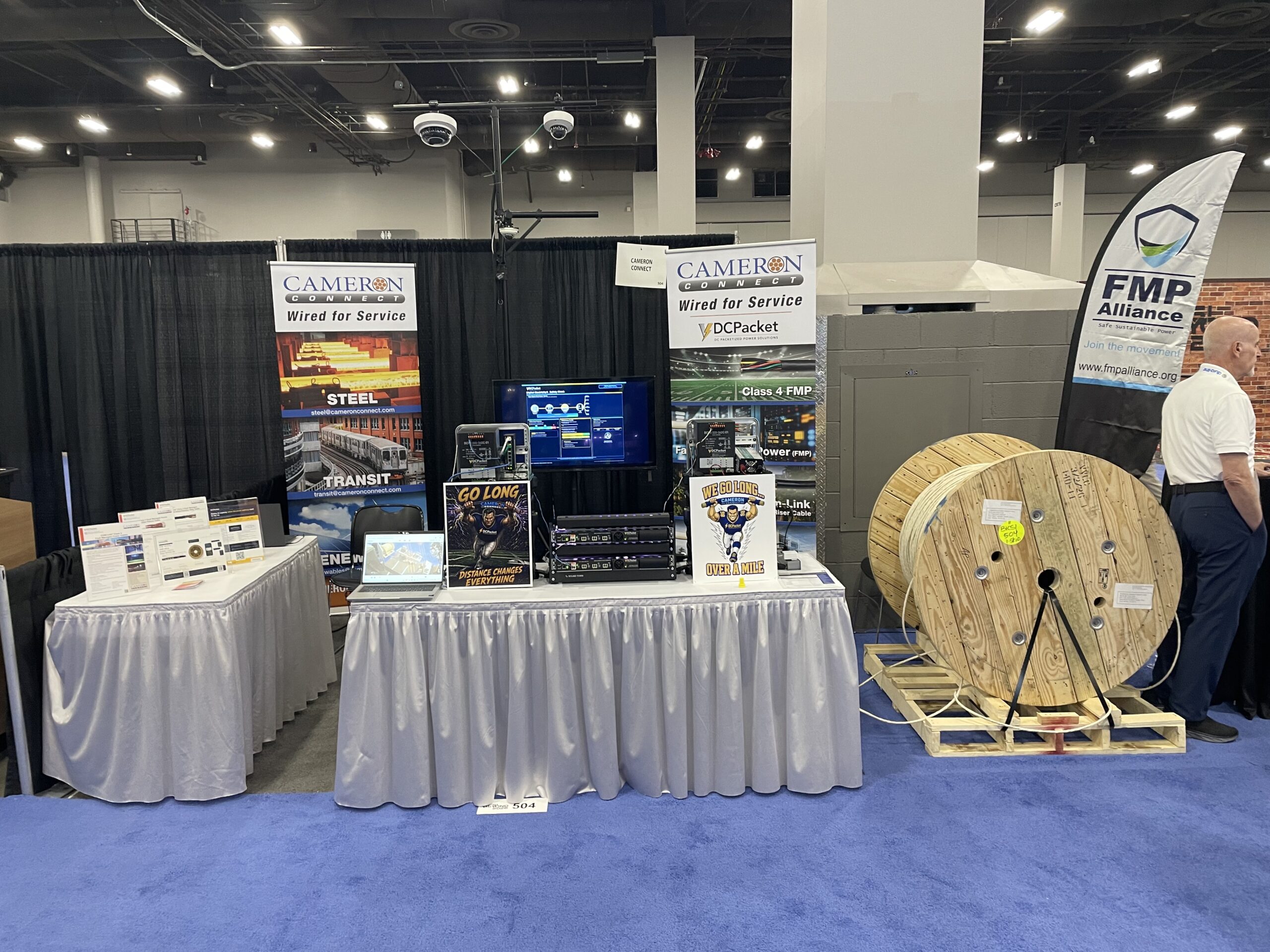
Cameron Connect's BICSI Booth
Categories News

Cameron Connect at BICSI: Demonstrating What the Future of Power Delivery Could Look Like

Earlier this month, Cameron Connect shared a booth with DCPacket at the BICSI Conference in Las Vegas. But this wasn’t your average trade show booth—every camera, computer, and TV was powered by one mile of Fault-Managed Power (FMP) cable, specifically 16 AWG 4PR Class 4 cable, spooled on a reel for visitors to see.
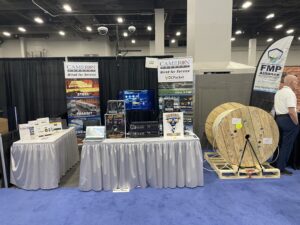
Cameron Connect's BICSI Booth
Cameron Connect’s booth was powered by one mile of 16 AWG 4 PR Class 4 Cable.

A Crowd-Drawing Demo

Having a visual demonstration of how FMP cable works drove plenty of foot traffic to Cameron Connect’s booth. More than 1,000 people attended the BICSI Conference, and more than 200 people paid Cameron a visit to see what FMP can do.

“We ran the booth power into the DCPacket transmitter where it converted the electrical power into energy packets which then ran through the mile of cable and into the DCPacket receivers,” says Jason Campbell, general manager for Cameron Connect. “From the receivers, we were able to power everything in our booth.”

What’s even more exciting? FMP can do much more than power one 100 square-foot booth.

FMP On the Ground

The booth was a small proof point for a technology built to work on a much larger scale. FMP delivers stronger power without the cost and rigidity of infrastructure. Instead of capping power output at the source, FMP continuously monitors the line for faults and cuts power off in milliseconds if something is wrong. That safety-first approach lets FMP deliver higher voltage and power than conventional systems, which is why it’s applicable across industries, including stadiums, campuses, data centers, hotels, transportation networks, and manufacturing.

If you’re curious about how FMP applies to these six industries specifically, we broke it down for you in a recent blog post.

Compared to traditional Class 2 low-voltage systems, industry data shows that FMP can deliver up to six times the power using fewer, thinner copper pairs, cutting material and installation costs along the way.

A Regulatory Green Light

FMP’s flexibility is also behind a key regulatory shift: the 2023 National Electric Code (NEC) created a specific classification for FMP systems, known as Class 4. Rather than mandating a specific engineering approach, the classification limits how much energy a fault can deliver. In practice, that means FMP installs can now be approved without a custom engineering review each time—the regulatory piece that made a demo like BICSI possible, and that’s opening the door for FMP well beyond a trade show floor.

“Knowledge around Class 4 technology and solutions continues to increase along with the acceptance across multiple applications,” Campbell says. “The response from those who visited the booth was overwhelmingly positive, and we can’t wait to see the reception from attendees at BICSI’s winter show in Orlando.”

What’s Next

Orlando will be the next test, but the bigger opportunity lies well beyond any single trade show floor. As acceptance grows, so does the range of places FMP can show up next—including yours. Curious about what FMP may look like in your stadium, hotel, or manufacturing facility? Reach out to our team.

City lit up with lights. | Photo by Arturo Castaneyra
Categories News

Power Has a Missing Middle. Here’s What Fills It.

Most projects get forced into a false choice: run Alternating Current (AC) power farther than it’s efficient to go, or push Power over Ethernet (PoE) past the low-voltage range it was built for. But the technology isn’t the problem—it’s the missing layer between them. That layer is Digital Electricity (DE).

Together, these three technologies form a relay: AC provides the dependable power source, DE distributes it, and PoE delivers the final, device-ready connection. Redesigning the pathway this way lets existing technology reach farther, scale faster, and skip the cost of new wiring.

How DE Changes the Power Delivery Game

  • Which projects are economically viable: When the cost of extending power kills a project, DE makes the pathway cheaper. Removing the cost of a power run can be the difference between a device staying in scope and getting cut.
  • How early power enters the technology design: DE architecture works better in reverse. When the power pathway is designed alongside the technology from the start, the two are optimized together.
  • How electric and low-voltage scopes coordinate: Electrical and low-voltage trades are typically designed and bid separately, with little coordination between them. DE sits across that boundary, so both trades have to work from the same plan instead of handing off a finished electrical scope for low-voltage to work around.
  • Where backup power and control reside: In a conventional setup, backup power and control typically live at the edge, duplicated at every device. DE centralizes power distribution, so backup power and control can live at a single upstream point instead.
  • How distributed systems scale across facilities and portfolios: Since DE architecture doesn’t depend on site-specific AC infrastructure, the same design can be deployed across multiple facilities in a portfolio that requires much less rework.

Every piece of tech doesn’t need to be replaced, but every piece that works should be connected.

One Cable, More Than a Mile of Power

DCPacket runs on Fault Managed Power (FMP), the technology behind DE that allows a single low-voltage cable to safely carry higher power over long distances, with continuous fault detection built in. Here’s what that looks like on the ground:

A single Class 4 16 AWG 4-pair run—no thicker than standard network cabling—can run more than a mile away from the power source and still power construction cameras, gate readers, lighting, and edge devices across an entire construction site. Every device on that run is actively monitored, fault managed, and relocatable as the job expands.

“The distance is huge because everybody is trying to figure out how to get power farther while doing it more efficiently,” says Todd Croteau, VP of Business and Partner Development at DCPacket. “This is the missing middle between AC and PoE.”

Knowing FMP can do this is one thing; building it into real projects is DCPacket’s job.

Making the Technology Deployable

DCPacket is how that DE layer gets deployed. It doesn’t replace AC or PoE, it combines them through a power infrastructure designed for distributed technology. As a result, projects don’t have to be reduced, delayed, or abandoned because the power pathway costs more than the technology it supports.

DCPacket is what makes those shifts practical, not just theoretical. It changes the economics by acting earlier: bringing the pathway into the design phase, engineering the right architecture, coordinating the ecosystem, and carrying it through installation and commissioning.

The technology makes a meaningful difference in the following scenarios:

  • Stalled projects where the conventional power source is preventing approval.
  • Value-engineering events where the technology scope is about to be removed.
  • Portfolio repeatability where the same remote-load problem repeats across sites.
  • Early design where power architecture shapes the basis of design.

When power is designed in from the start instead of patched in after, the technology doesn’t just get installed; it gets to scale.

Supply Chain: Cameron Connect x DCPacket

Earlier this year, Cameron Connect partnered with DCPacket to supply cable for its FMP deployments. For DCPacket, the partnership strengthens the supply chain for the specialized, limited energy cable required in FMP distribution, ensuring on-time deliveries. For Cameron Connect, the partnership helps the company establish itself as a trusted supply partner in the FMP landscape.

To put faces to names, Cameron Connect and DCPacket will share a booth at the BICSI Conference in Las Vegas from Aug. 30 to Sept. 2. Attendees can see DCPacket’s product portfolio in action at booth 504—representatives from both companies will be there to answer questions and talk through deployment details.

Whether you attend BICSI or not, the question is the same: how much farther could your next project go if power wasn’t the limit?

Inside of a data center. | Photo by Matthieu Beaumont
Categories News

Cameron Connect and DCPacket Team Up on Fault Managed Power at BICSI

In July, DCPacket—the leading deployer of digital electricity (DE) in data centers and AI factories across the U.S. and Canada—partnered with Cameron Connect to supply cable for Fault Managed Power (FMP) distribution deployments. At this year’s BICSI Conference in Las Vegas, the two companies will share a booth to showcase the partnership from Aug. 30 to Sept. 2.

Cameron supplies the cables behind DCPacket’s product portfolio, which together can cut installation costs by up to 50% and detect faults in real time, supporting hyperscale AI with sustainable infrastructure.

A statement on DCPacket’s website reads: “This partnership strengthens DCPacket’s supply chain for the specialized, limited energy cable required in fault managed power distribution—supporting reliable, on-time delivery as DCPacket scales its AI Micro Data Center and critical infrastructure deployments across North America.”

FMP’s Potential in Data Centers

AI workloads are pushing data centers toward higher power density and faster buildout timelines than ever before. The most common power source in data centers—alternating current (AC) power—struggles to maintain peak performance because it wastes energy during voltage and frequency conversions. Its cables also take up unnecessary space.

Direct current (DC) power has historically been avoided in data centers due to safety concerns—it has not been able to maintain high voltages safely and requires bulky protective hardware. FMP changes that equation, combining real-time fault management with digitally controlled distribution to improve both safety and efficiency.

FMP takes on three core challenges in data center power distribution:

  • Wasted energy: Reduces physical material and increases power density, allowing operators to distribute more power in the same footprint.
  • Human safety risks: Shuts down power in less than a second after detecting a short circuit or human touch.
  • Limited space: Eliminates the need to overbuild capacity upfront, letting infrastructure scale with demand rather than in anticipation of it.

“As Cameron Connect further establishes itself as a trusted supply partner in the FMP landscape, the partnership with DCPacket is critical,” says Tom Stone, National Sales Director of Critical Infrastructure at Cameron Connect. “Supporting DCPacket’s Fault Managed Power solution suite with our Class 4 cable inventory allows both organizations to deliver maximum value to the marketplace.”

FMP backs every AI Micro Data Center deployment from DCPacket.

A Closer Look at DCPacket’s AI Micro Data Centers

Hyperscale, gigawatt AI campuses are becoming harder to power, permit, and site in local communities. In response, DCPacket builds data centers that are smaller, modular, and fully automated. They can run on standard available power, create minimal community friction, and can be deployed in weeks once they’re funded.

This model avoids the common challenges that traditional, hyperscale data centers face:

  • Excessive power and water demands
  • Siting and permitting delays in rural and suburban areas
  • Community resistance, leading to stalled or stranded projects
  • Limited vendors for hyperscale-specific builds

Visit the Booth

See DCPacket’s product portfolio in action at Booth 504, where the Cameron Connect and DCPacket teams will be available to talk through deployment details and answer questions.

Timelapse photo of vehicles and electricity. | Photo by Pawel Nolbert
Categories News

Six Challenges, One Fix: How FMP Can Power Every Industry

Power distribution has long relied on traditional electrical infrastructure and low-voltage Power over Ethernet (PoE), but Fault Managed Power (FMP) is changing that. By making high-voltage power delivery safer and more efficient, FMP is reshaping how essential spaces get power where they need it: stadiums, campuses, data centers, parking lots and airport terminals, and manufacturing facilities.

1. Stadiums

In stadium settings, FMP improves cellular wireless connections, cameras, sensors, signage and lighting. One clear example of this is Hard Rock Stadium in Miami, where an FMP system, detailed in a case study from VoltServer, was implemented to solve a major connectivity challenge: the stadium needed high-speed internet capable of supporting 10,000+ users at the same time.

FMP was the clear choice because it can deliver thousands of watts of power over long distances effectively, making it well suited to power the stadium’s radio communication infrastructure. As a result, Hard Rock Stadium was able to support high-speed connectivity, turning a bottleneck into a strength.

2. Campuses

Beyond stadiums, hospitals and campuses can also benefit greatly from FMP’s long-distance power solutions. Since PoE solutions can only reach 100 meters or less, they’re an ineffective solution for larger hospitals and smart buildings. FMP doesn’t have that limitation, so it can reach the farthest corners of a campus without extra infrastructure.

Safety is just as important here as reach. Since hospital personnel are hands-on with equipment themselves and with patients, the enhanced safety component of FMP solutions is essential. If a line is cut or touched by a staff member or a patient, it shuts off instantly, protecting everyone nearby.

3. Data Centers

Data centers face a different challenge: extremely high, concentrated power demand. Before FMP, operators relied on traditional infrastructure that wasted energy, took up too much space, and created safety risks.

FMP addresses all three of these challenges. The cables use space efficiently, distribute power more evenly, and support more precise control to cut down on operating costs. By combining real-time fault monitoring with digitally controlled distribution, FMP enables data centers to run safer and more streamlined than traditional systems.

4. Hotels

Hotels bring a different kind of demand: lighting, window treatments, and temperature control spread across many floors. According to an article from Electrical Contractor, tech-heavy hotels increasingly rely on FMP to carry power from the basement to the upper floors, using far less space than traditional bulky cabling would require.

This efficiency also makes more luxurious guest experiences possible. High-end hotel brands are using FMP to power smart mirrors in bathrooms, touch screens at the entrance of every room, and custom light configurations. One hotel in Fort Worth supports more than 8,000 light fixtures on PoE technology without any conduit—a setup made possible by FMP.

5. Transportation Networks

Transportation hubs present one of the toughest distribution challenges: airport terminals, parking garages, and railway stations. VoltServer worked with several industry partners to develop an FMP solution for a large municipal transit agency operating across a large network of tunnels, stations, and tracks in an urban environment.

Since FMP has a wider reach than traditional electrical infrastructure, the agency can successfully deliver power to the farthest areas of the rail system. The result was smoother operations and stronger communication across the entire hub.

6. Manufacturing

Manufacturing facilities benefit from FMP in a more structural way. Rather than routing every connection through one central server, FMP lets companies place small networking hubs throughout an entire facility. That decentralization eliminates the need for additional infrastructure and long cable runs. And since fewer components are required overall, installation takes less time and costs less money.

These advantages translate into daily operations: FMP helps manufacturers flag equipment problems before they escalate, power AI-driven charging stations, and manage supply chain logistics—all while delivering the safe, reliable power the industry needs.

The Universal FMP Advantage

From packed stadiums to quiet hospital wings, from data centers to parking garages, the same advantages keep showing up: FMP delivers power over far greater distances than PoE, and it does so with a safety mechanism that shuts off at the first sign of trouble. That combination makes FMP a viable alternative to traditional electrical infrastructure across every industry that needs reliable power.

City skyline with bright lights. | Photo by Marc-Olivier Jodoin
Categories News

What’s the Difference Between FMP, Digital Electricity, and Class 4?

The terms Fault Managed Power (FMP), Digital Electricity, and Class 4 are often used interchangeably in power delivery. They’re related, but not the same thing. For companies that source and install cable, knowing the difference between all three terms matters.

The Problem FMP Solves

For years, power distribution came down to two options: traditional electrical infrastructure or low-voltage power like Power over Ethernet (PoE). Traditional infrastructure was expensive and inflexible, and PoE was too weak for most applications. FMP closes that gap by delivering strong power without the cost and rigidity of traditional infrastructure.

FMP: The Concept

Standard, low-voltage classifications (Class 2 and Class 3) cap power output at the source. Instead, FMP continuously monitors the line for faults and cuts power off in milliseconds if something is wrong. That safety-first approach lets FMP deliver higher voltage and power than older, low-voltage standards can.

Digital Electricity: The Proof

Digital Electricity is Voltserver’s specific implementation of FMP. It sends power bursts (500 times per second), running a safety check between each one. If something goes wrong—like accidental human contact, a short circuit, or a ground fault—the system shuts down instead of sending another burst. DE was among the first proven FMP systems to prove that the concept actually works at scale.

Class 4: The Code Classification

Class 4 is the classification the 2023 National Electric Code (NEC) created for FMP systems. Rather than mandating a specific engineering approach, it limits how much energy a fault can deliver. This sets a safety outcome that every FMP system can achieve. As long as it meets the right requirements, any FMP system can qualify as Class 4, regardless of how it was built.

Comparing Class 2, Class 3, and Class 4

Class 2 Class 3 Class 4
Power limit Capped at the source Capped at the source Limited during fault events
Safety method Limits the energy current Limits the energy current Active fault monitoring
Power delivered Low (PoE range) Medium High (supports long-distance power runs)
Distance capability Limited Limited Long distance without power loss
Installation Simple, low-voltage rules Simple, low-voltage rules Once certified, it’s installed the same way as Class 2 and Class 3
Use cases PoE devices and sensors Low-voltage equipment Data centers, manufacturing, stadiums

Note—Digital Electricity isn’t a separate classification, it’s a specific implementation that qualifies as Class 4.

Understanding the classification is one thing. Deploying it is another. Once a system qualifies as Class 4, the next question companies have to answer is: Who is qualified to install it?

Who Can Install FMP Systems?

A common question surrounding FMP systems is whether only certified electricians can work with them. According to the FMP Alliance, that decision is ultimately made by local jurisdictions.

“Your local building jurisdiction really determines what work a contractor is licensed to do,” Ronna E. Davis, secretary for the FMP Alliance, shared on LinkedIn. “This is based on safety and contractor qualifications.”

According to the National Fire Protection Association (NFPA), the 2023 NEC is currently in effect in 25 states, with adoption still expanding. Since the code is revised every three years, Class 4 recognition is only expected to grow. Davis encourages businesses to pay attention to these local jurisdictions, as they ultimately decide whether a licensed electrician is required or not.

From a technology standpoint, she says, FMP is a relatively safe technology to work with. Many businesses tend to wonder if their electrician needs to have the same safety training as those who work on systems that are more dangerous—Davis says no.

“The answer is technically no,” she explains. “But you do need a qualified electrical professional to install these systems. FMP systems need to be installed professionally, as it requires an advanced skill set.”

FMP is practical to deploy at scale because entry barriers are low, even though the technical rigor behind it is real. It’s worth stepping back to see how the pieces add up.

How FMP, Digital Electricity, and Class 4 Work Together

FMP is the concept, Digital Electricity is the proof, and Class 4 is the code that recognizes it. Companies are no longer forced to choose between strong and safe or between fast installation and long-distance reach. For anyone sourcing and installing cable, that’s the whole point.

Blue wire cables. Photo by Scott Rodgerson
Categories News

Power Is Evolving. Is Your Infrastructure Keeping Up?

By 2050, the demand for electricity will increase by 125%—and the world isn’t prepared to keep up with it.

For the next eight years, 81,000 electricians are expected to retire annually in the U.S. And with a lack of people pursuing careers in electricity, there’s no one to pass their knowledge on to. As a result, the current two-year lead times for wire cables will likely stretch even longer.

That’s where Fault Managed Power (FMP) solutions come in, designed to ease the strain on an industry that’s already stretched too thin.

Suitable for manufacturing, transportation, and data centers, FMP solutions deliver reliable, low-voltage transmission over long distances. Cameron Connect, which sources its VoltServer FMP cable through manufacturing partner Marmon IEI, brings these advantages to its partners in these three industries.

Here are a few things companies working in these areas should know about FMP solutions, from how they work to the potential benefits they have to offer in each industry.

How Does FMP Work?

Traditional electrical infrastructure is expensive, difficult to install, and can be dangerous. Powering remote locations like Wi-Fi antennas and cameras is especially challenging and costly.

Rather than relying on alternating current (AC) and direct current (DC) power alone, FMP solutions send small bursts of digital electricity 500 times per second—between each one, the system runs a safety check. If someone touches a wire or something else goes wrong, the power cuts off in milliseconds. This makes electrocution and fires much less likely.

Utilizing digital electricity is the main thing FMP solutions do differently than traditional power sources. As a result, they help reduce labor, equipment, and maintenance costs while making it easier to coordinate across multiple crews.

FMP plays a different role in each industry it serves. This piece will focus on the markets Cameron Connect works with specifically and how FMP solutions impact those clients. These markets include manufacturing, transportation hubs, and data centers.

Market 1: Manufacturing

FMP offers distinct advantages in manufacturing environments. Instead of routing everything through one central server, FMP lets companies place small networking hubs throughout the facility. This keeps industrial devices connected without long cable runs or extra infrastructure.

FMP also reduces the setup time and costs of getting a network up and running, as it has fewer components to install and requires less specialized labor.

Here are a few instances where FMP delivers safe and reliable power to streamline processes in the manufacturing industry:

  • Quality assurance: Machine-learning (ML) sensors installed throughout the facility can flag maintenance problems before they happen.
  • Manufacturing process: FMP powers AI robots and the charging stations that keep them running.
  • Supply chain: AI-powered inventory, demand forecasting, and transportation logistics.

FMP brings these same advantages to transportation networks, where power needs to reach sprawling and hard-to-access infrastructure.

Market 2: Transportation Networks

From railway stations to terminal technologies, FMP supports smarter and more sustainable transportation hubs. These include:

  • Railway stations: Signaling systems, rail yards, ticketing systems, and tunnel infrastructure.
  • Airport terminals: Emergency response, parking and rental facility security, and communication between passengers.
  • Roadway infrastructure: Tolling systems, roadside emergency communication, and traffic management systems.

VoltServer worked with several industry partners to develop an FMP solution for a large municipal transportation agency that had an extensive network of tunnels, stations, and rail tracks in an urban environment. The FMP technology could transmit power up to 2 kilometers, which surpassed the limitations of traditional AC distribution methods.

With this extended reach, power was reliably delivered to the farthest, most remote areas of the rail system. This helped operations run more smoothly and improved communication.

Where traditional infrastructure hit its limits, FMP kept going.

Market 3: Data Centers

With AI integration challenges and rising power demand, FMP helps operators use space and materials more efficiently, distribute power evenly, and keep up with rising demand. FMP also supports energy control and monitoring to reduce operating costs.

While they’re the most common power source in data centers, AC setups often waste energy during voltage and frequency conversions. This makes it challenging to maintain peak performance—their large cables also take up more space than an FMP solution.

DC isn’t the preferred power source for many data centers due to safety concerns, until FMP addressed those concerns directly.

Previously, DC power struggled to maintain high voltages and needed bulky hardware to protect operators from faults. But when FMP entered the picture, it combined real-time fault management with digitally controlled distribution to improve safety and efficiency in data centers.

Here are a few advantages of using FMP-DC power solutions in data centers:

  • Accelerated sustainability and efficiency: Distributes power and data in the same volume, increases density, and reduces physical materials.
  • Improves DC power safety: Distributes high-voltage DC power over long distances to better support server systems.
  • Supports scale and maintenance: Grows with demand, eliminating the need to overbuild from the very beginning.

The industries Cameron Connect serves can’t wait on two-year lead times or shrinking labor pools. FMP shortens timelines, reduces costs, and grows with demand, so the infrastructure built today doesn’t become a liability tomorrow.

worker in a steel mill
Categories News

Why Routine Maintenance Is a Steel Mill’s Most Important Investment

In a steel mill, a skipped maintenance check can be the difference between a productive day and a catastrophe.

“Safety should be a top priority for steel mill workers,” says Jim Vaughan, national director of steel sales for Cameron Connect. “There’s a lot of equipment, a lot of heat, and a lot of electricity.”

This makes maintaining the steel mill critical. The equipment and cables that keep the mill running aren’t going to last forever. As a cable supplier, Cameron Connect recognizes that.

“There’s no perfect cable for a steel mill,” he says. “We used to tell people that if you think you have a product that can survive anything, put it in a steel mill and see what happens.”

In steel mill environments, equipment and cables degrade faster than anywhere else. Rather than waiting for a cable to fail or equipment to break down, operators should protect themselves by performing routine maintenance.

What Happens When Operators Defer Maintenance?

If operators don’t plan routine maintenance, Vaughan says, then maintenance will schedule it for them.

“If you don’t maintain your equipment, then it will break down at the most inopportune time,” he explains. “Most of our customers have scheduled downtime to do maintenance, and that’s definitely something they should be doing.”

When operators defer maintenance, it puts them in a critical position. The equipment that broke needs to be replaced as soon as possible. This typically means they have to pay a higher cost for the cable as well as an expedite fee—but that’s not all.

“If they weren’t able to bring the plant down properly, there could be lost product, lost materials, and lots of other issues,” Vaughan says. “It’s big dollars, especially for the bigger steel mills.”

Why Do Operators Defer Maintenance?

Steel mills defer maintenance for several reasons. In recent years, Section 232 Tariffs, which reduced steel imports and shifted demand toward American steel producers, have caused many mills to push their capacity.

“The tariffs have resulted in significant investment in steel production in the U.S.,” he says. “Everybody’s sales have increased, so their outputs have increased.”

This is more of an issue for smaller steel companies, as larger companies have the ability to shift production. Bigger steel companies perform the same tasks in different areas of the mill—smaller mills do not. As a result, they can’t shut down a “redundant” part of the mill like the big mills can.

Working closely with a supplier like Cameron Connect makes deferring maintenance much less of an issue. By helping steel mills respond to the expedited schedule and ensuring they use high quality cables, the company helps keep the steel mills running.

What Happens When Routine Maintenance Fails?

Cameron Connect only sees a dozen emergency situations per year. And while that may seem like a small number, a steel mill outage is no small problem.

“When a mill goes down and the plant doesn’t have redundancies built into its systems, it could be a ‘completely down’ situation,” Vaughan says. “If something goes out, there’s usually going to be an incident that takes out equipment, conduit, cabling, and sometimes personnel. This could also cause additional problems downstream.”

While these situations are disastrous and sometimes preventable, it’s possible for steel mills to recover. Cameron Connect keeps a constant inventory of the cables and configurations that are used in all areas of the mill.

“Being partnered with the right wire supplier that knows what you need and how to address the impact of an incident is critical,” he explains. “They need to get back up and running as soon as they can because downtime is dollars.”

Knowing how to respond matters. But for most mills, emergencies are the exception.

How Can Steel Mills Shift to Preventative Maintenance?

According to Vaughan, about 80% of U.S. steel mills are on a routine preventative maintenance schedule. It’s worth noting that most of these mills are newer ones—it tends to be a different story for older steel mills.

“Many older mills start servicing or planning an outage based on where they think it will fail in the near future,” he says.

Unlike larger, updated mills that can shift production to other areas, older mills rarely have that flexibility. Auditing equipment, establishing baselines, and building inventory requires downtime—and dollars—they simply cannot afford.

Cameron Connect aims to make this transition easier. It often works closely with a steel mill’s maintenance team, encouraging them to be aware of long lead times should an emergency situation occur.

“We’ll help mills build a wire and cable inventory so they can respond to these situations fast,” he says. “We encourage them to develop critical spares continuously, ensuring they have what they need in stock.”

For steel mills operating on a reactive schedule, the message is clear: the cost of preventative maintenance is much less than the cost of recovery.

Steel mill
Categories News

When Specs Go Wrong, Steel Mills Pay the Price

Like many professions in the skilled trades, the steel sector is sourcing from a shrinking labor pool.

This affects all players involved in steel projects, including engineers, suppliers, and electricians. But electricians face the steepest shortfall. In fact, The Bureau of Labor Statistics estimates that there will be a shortage of 81,000 electricians every year between 2024 and 2034.

“The part that really affects us is the lack of electricians,” says Jim Vaughan, national sales director for steel at Cameron Connect. “Labor-wise, it all comes back to the shortage of electricians.”

When crews are stretched thin, spec errors slip through the cracks. And getting the wrong specs can push a project well past its deadline.

“About 80% of the materials are accurate for the proportions that are designed,” Vaughan says. “That means there are constant fire drills going on because they recognize that they need a cable but it wasn’t built into the bill of materials.”

Avoiding those fire drills starts before the cable order goes through.

Working With the Right Supplier Matters

When a cable doesn’t meet the right specs, steel mills must rely on suppliers to identify the correct cable needed on-site.

“They really need to work with a supplier that specializes in these types of projects,” Vaughan says. “This enables them to continue making progress.”

But what happens when a supplier isn’t available for immediate customer support? The answer may lie in who’s left to pick up the phone.

“From a wire distribution perspective, the industry is built on the foundation of the talent that sat at the desk,” Vaughan says. “In 10 years, that talent is going to age out of the workforce.”

The expertise sitting behind the desk is extremely valuable. When someone calls in looking for a specific cable they can’t find online, these industry experts can save a project deadline and ensure the steel mill is designed with cables that have been sourced and specified correctly from the start.

That knowledge gap is widening on the procurement side, too. For suppliers, it’s clear that many present buyers don’t come from the wire cable space or aren’t familiar with it.

“When I have an electrician saying they need a six-gauge red cable, it’s up to us to dig in and find out what the application is,” Vaughan explains. “So I think the service we’re providing will grow exponentially over the next 10 years.”

The Need for Experienced Support

As veteran contractors retire and newer, inexperienced contractors take their place, working with a knowledgeable cable supplier is more important than ever.

Vaughan and his team draw on experience from both sides of the industry.

“We bring experience and expertise from both the desk standpoint and the field standpoint,” he says. “We don’t spend all our time waiting for a phone call or sitting behind the desk waiting for an email.”

When a new contractor is assigned to a project, they’re expected to get to work as soon as possible. This means they don’t have time to research what cables they need or whether the information they’re receiving from engineers is correct.

As a result, the supplier must take the information they’re given from contractors, verify it, and figure out which cables they need to complete a project.

Their job gets much more difficult if an incorrect cable has already been ordered.

The Cost of Getting the Wrong Cable Specs

If the wrong cables arrive on-site, it costs the project owner more than money.

“When they order the wrong cable, they find out when it’s delivered,” Vaughan explains. “So you’re driving the cost up, you have to wait till the other cable gets there to keep working, and that all compounds to delays.”

In the steel industry, every day is project-oriented. There are daily spot buys that suppliers complete, and it’s all done within projects—making it that much more important for deadlines to be met.

Delays are inevitable at times, and mistakes will be made. Cameron Connect makes a conscious effort to prepare for them by keeping popular cables in stock.

“We’re constantly looking ahead based on the progress of the project to make sure we have material on order,” Vaughan says. “We know what configurations will be needed next, and we put those into production to make sure we have the right cables when customers need them.”

Staying ahead of demand will be even more important if workforce gaps continue to widen.

Filling Workforce Gaps

With less experienced contractors, engineers, and electricians working on steel mill projects, cable suppliers have had to be more hands-on.

“We get requests from customers daily asking what kind of cable they need,” Vaughan explains. “We’ll give them a list of questions to ask the engineers, which makes them sound more intelligent in the long run, which helps them dial into the correct cables. And once we get the answers from them, we’ll give them the cable form they need.”

For steel mills navigating a shrinking labor pool, a supplier who can ask the right questions and source the right cable isn’t nice to have. It’s how a project gets done on time and on budget.

Steel mill interior
Categories News

The Best Distributors Don’t Act Like Distributors

In the steel industry, distributors win on trust that carries from project to project and company to company. Cameron Connect’s success in the steel sector stems from treating every contractor and manufacturer as a long-term investment rather than a transaction.

“The relationships we have with our manufacturers are just as important as the ones we have with our customers,” says Jim Vaughan, national sales director of steel for Cameron Connect.

After spending more than two decades in the steel industry, Vaughan has experienced the significance of business relationships first-hand. His first clients have lasted his entire career; he continues to work on their projects even now.

Trickle-Down Relationships

When people join the steel workforce, Vaughan says, they hardly ever leave. While his first clients may not work for the same company, they’re still active in the industry and take on similar roles elsewhere.

As those individuals move companies, Cameron Connect moves with them. This expands the relationship rather than resetting it. “We started chasing projects along with them, and it continues to grow from there,” he says.

That growth only compounds. His trusted long-term partners have broadened his network by introducing him to other companies.

This partnership-driven model takes territory out of the equation entirely, as he now has business partners in several states across the country.

“We follow projects with these people as they move from plant to plant,” Vaughan says. “Regionality isn’t really a thing with us.”

What This Means for Steel Companies

Strong relationships ensure projects perform better for both contractors and manufacturers. Since each team has experience working with the other, expectations and workflows are familiar to both parties. This often prevents project delays.

Supply challenges and design changes are inevitable. Established relationships across construction, engineering, and procurement make it easier to resolve problems faster. Cameron Connect’s familiarity with steel capital projects across applications allows them to respond quickly. This includes unexpected wire needs that appear on a weekly (sometimes daily) basis.

Perhaps most importantly, trusted relationships reduce financial risk. Trust isn’t tangible, as it shows up in how business is handled.

“We trust each other to do the right thing every time,” says Vaughan. “With all the manufacturers and contractors I’ve worked with in the last 20 years, I’ve never had to write off an invoice.”

These relationships aren’t limited by geography. Since Cameron Connect moves with their partners—and often forms new partnerships in response to that—neither team has to start over when people move companies. The network of trust only expands and continues to move forward.

But this model isn’t common across the steel industry.

Cameron Connect sets itself apart as a long-term partner in the steel industry network.

Why Most Distributors Can’t Operate This Way

In most distributor environments, long-term relationships aren’t at the top of the priority list. Geography limits how relationships are built, and manufacturer relationships are treated separately from those with clients.

This structure makes it difficult to invest in relationships that don’t translate into revenue or to follow people when they switch companies. Cameron Connect operates differently.

Vaughan handles all of the mill’s cable buys, working directly with the owner and the electrical construction crews. In many ways, he is an extension of the team.

“We’re not technically an employee,” he says. “Right now they have 2,000 people out there with all the different trades, and we’re probably the only ones not billing for their time.”

You Can’t Separate the Model from the People

When people join the steel workforce, they’re typically in it for the long haul. And if they plan to have a 20-year career that’s fulfilling, Vaughan says, they must be passionate about their work.

“I love being out in the mill, I love working with contractors, and I love working with my customers,” he explains. “I’ve developed good friends throughout the years, and we do right by each other every time.”

On top of building relationships with customers and manufacturers, it’s important to have team members who share the same passion and value their professional connections.

“I’m a part of the best team in the industry with Mike Broz and Joe Garbus,” Vaughan says. “We’ve worked at three companies together, and you won’t find someone who knows more about the inside of the industry than those two.”

For Cameron Connect, relationships transcend company titles. The most important, long-lasting ones hinge on interpersonal conversations that last an entire project and beyond. For Vaughan, this means being a reliable partner when it matters most.

“When these guys get into the industry, they don’t leave,” he explains. “So we always want to be the company they call.”

inside a steel mill
Categories News

Greenfield and Growing: An Inside Look at America’s Steel Revival

American steel mills are booming. Jim Vaughan, director of steel sales for Cameron Connect, is currently working on one of the largest greenfield projects in the U.S.—and he doesn’t see momentum slowing down any time soon.

This wasn’t always the case.

Only eight years ago, most American steel mills were either idled or only working a few days a week. Foreign producers started shipping subsidized steel into the U.S. at prices domestic producers couldn’t match. Once Section 232 Tariffs came into place, in 2018, domestic steel began its comeback as mills that had gone dark began reopening.

The Unexpected Side Effects of Tariffs

As idled steel mills came back online, the impact of the tariffs was felt throughout the industry. Section 232 Tariffs reduced imports and generally shifted demand back toward domestic producers, contributing to higher prices and renewed production across U.S. mills.

The tariffs reshaped pricing, production, and where steel gets made.

What’s been less predictable is how foreign companies and manufacturers have responded.

“Companies outside of the U.S. are buying our domestic manufacturers or starting to build here to avoid paying the tariff,” Vaughan says.

This shift is driving a surge of new greenfield projects in the U.S., ultimately meeting demand without the added cost of tariffs.

The result is the same: Steel production has moved back to the U.S. Cameron Connect plays an essential role in keeping these projects on schedule and aligned with spec.

Cameron Connect’s Role in the Greenfield Boom

Greenfield projects are built from the ground up. This poses challenges around lead times and the price contractors pay for a wrong order—especially when they’re on a strict timeline.

“For greenfield projects, the goal is to get everything up and running as fast as possible,” he says. “They want to start generating some kind of revenue for the amount of money they’re putting into the project.”

Since greenfield projects have so many unknowns, Vaughan encourages companies to include Cameron Connect early on in the planning process so they can advise on lead times and cable specifications. Confirming cable specs is where confusion typically occurs across teams.

“Electricians, contractors, manufacturers, and engineers all have their own cable descriptions,” he explains. “We take all of those into account and come up with the type of cable we know they’re looking for.”

These differences may seem minor, but they can be detrimental to the project. Mismatched specifications can delay procurement and create installation issues that ripple across the entire project. Ensuring alignment early on will prevent costly adjustments closer to the startup date.

For instance, most steel equipment comes from European manufacturers. Considering their cables are different from what’s available in the U.S., Cameron will take their measurements and convert the cable into something that is readily available and cost-effective locally.

Taking Unknowns Into Account

For companies tackling greenfield projects, planning for the unexpected is a part of the job. Even the best set plans hit a bump in the road.

“You have to plan for changes,” Vaughan says. “In one instance, we found an ancient burial ground, and you can’t move those. We had to cordon the area off, change the layout of some of the buildings, and change some of the pathways to feed power and utilities into the building.”

From Cameron Connect’s perspective, supplying cables to a greenfield project can be difficult. Vaughan finds it most effective to have 35% of engineering complete before bringing him on to the project, as he’ll have access to historical information based on the type of equipment installed.

Startup dates don’t move, and as that date approaches, timelines compress and cable demand becomes more urgent. “The last 30-35% of the project we need to have that material in stock so we can ship it the next day,” Vaughan explains.

What This Means for Contractors

Early alignment and execution under pressure are essential to the success of greenfield projects.

Even the slightest misstep in cable specifications, equipment sourcing, and timing can delay steel projects in a way that’s difficult to come back from.

That’s why Vaughan encourages companies to bring partners in early so they can establish trust long before the startup date arrives.

“Trust is important. Everyone involved should have a vested interest in making sure the project goes well,” he says. “The earlier customers and businesses choose their partners and the more open the communication, the better the project will be.”

As more greenfield projects come online, the margin for error continues to narrow. Coordination across teams becomes increasingly complex, especially as timelines remain strict and fixed. In a fast-paced environment built on startup dates, establishing strong partnerships determines whether a steel project stays on track or falls behind.

Cameron Connect

Hi! Let us know how we can help and we’ll respond shortly.


    This site is protected by reCAPTCHA and the Google Privacy Policy and Terms of Service apply.