
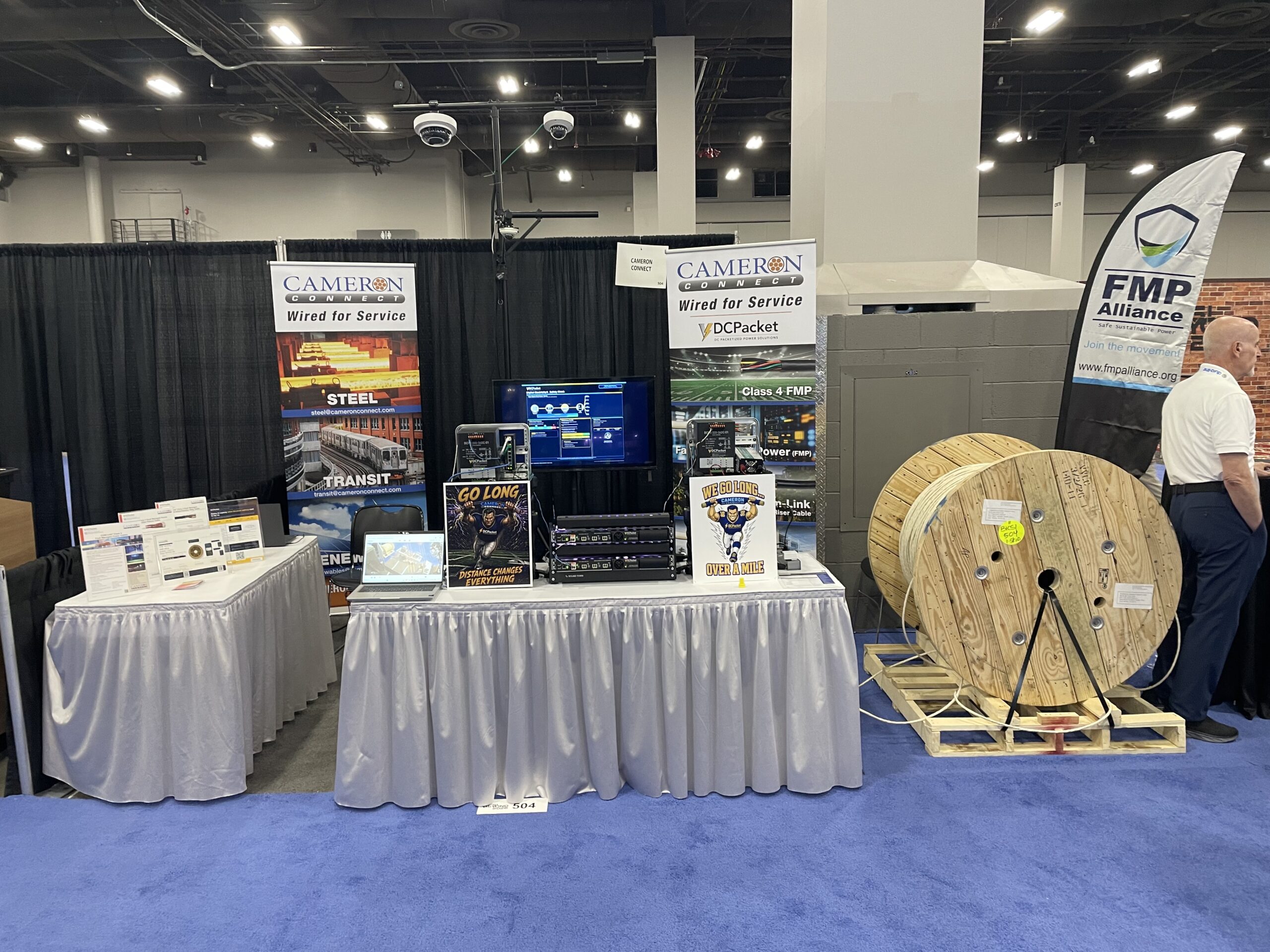
Earlier this month, Cameron Connect shared a booth with DCPacket at the BICSI Conference in Las Vegas. But this wasn’t your average trade show booth—every camera, computer, and TV was powered by one mile of Fault-Managed Power (FMP) cable, specifically 16 AWG 4PR Class 4 cable, spooled on a reel for visitors to see.
A Crowd-Drawing Demo
Having a visual demonstration of how FMP cable works drove plenty of foot traffic to Cameron Connect’s booth. More than 1,000 people attended the BICSI Conference, and more than 200 people paid Cameron a visit to see what FMP can do.
“We ran the booth power into the DCPacket transmitter where it converted the electrical power into energy packets which then ran through the mile of cable and into the DCPacket receivers,” says Jason Campbell, general manager for Cameron Connect. “From the receivers, we were able to power everything in our booth.”
What’s even more exciting? FMP can do much more than power one 100 square-foot booth.
FMP On the Ground
The booth was a small proof point for a technology built to work on a much larger scale. FMP delivers stronger power without the cost and rigidity of infrastructure. Instead of capping power output at the source, FMP continuously monitors the line for faults and cuts power off in milliseconds if something is wrong. That safety-first approach lets FMP deliver higher voltage and power than conventional systems, which is why it’s applicable across industries, including stadiums, campuses, data centers, hotels, transportation networks, and manufacturing.
If you’re curious about how FMP applies to these six industries specifically, we broke it down for you in a recent blog post.
Compared to traditional Class 2 low-voltage systems, industry data shows that FMP can deliver up to six times the power using fewer, thinner copper pairs, cutting material and installation costs along the way.
A Regulatory Green Light
FMP’s flexibility is also behind a key regulatory shift: the 2023 National Electric Code (NEC) created a specific classification for FMP systems, known as Class 4. Rather than mandating a specific engineering approach, the classification limits how much energy a fault can deliver. In practice, that means FMP installs can now be approved without a custom engineering review each time—the regulatory piece that made a demo like BICSI possible, and that’s opening the door for FMP well beyond a trade show floor.
“Knowledge around Class 4 technology and solutions continues to increase along with the acceptance across multiple applications,” Campbell says. “The response from those who visited the booth was overwhelmingly positive, and we can’t wait to see the reception from attendees at BICSI’s winter show in Orlando.”
What’s Next
Orlando will be the next test, but the bigger opportunity lies well beyond any single trade show floor. As acceptance grows, so does the range of places FMP can show up next—including yours. Curious about what FMP may look like in your stadium, hotel, or manufacturing facility? Reach out to our team.